2026 Best Mica Powder for Paint Global Buyers Guide?
Choosing the right Mica Powder For Paint requires more than comparing prices or reading bright product photos. In 2026, global buyers need dependable performance across architectural coatings, decorative finishes, industrial paints, and artist materials. A reliable mica grade should provide consistent particle size, clean color, strong light reflection, and stable dispersion. These details affect gloss, texture, coverage, and production efficiency.
This guide examines practical buying factors from a professional perspective. It considers natural and synthetic mica, wet and dry grinding, surface treatment, moisture content, whiteness, and batch consistency. Buyers should request technical data sheets, safety documents, sample quantities, and recent quality reports before approving a supplier. A small laboratory trial can reveal settling, poor wetting, or unexpected color changes that specifications may not show.
Real production conditions remain important. A powder that performs well in a test jar may behave differently in acrylic, epoxy, water-based, or solvent-based paint. Stirring speed matters. Storage humidity matters too. Even packaging can influence quality after long-distance shipping. Some suppliers describe similar grades differently, so direct comparison is not always simple. That is worth questioning.
This 2026 global buyers guide offers a careful framework for evaluating Mica Powder For Paint. It balances technical evidence, supplier experience, certification review, and application testing. No single product suits every coating system. The best decision usually comes from matching the mica grade with the paint formula, equipment, market requirements, and realistic production goals. Sometimes, the cheapest option costs more later.
What Is Mica Powder and Why Does It Matter in Paint?
Mica powder is a naturally layered mineral used to improve paint performance and appearance. Its thin platelets reflect light, create controlled shimmer, and can strengthen the coating barrier. In practical paint trials, mica often gives a smoother visual depth than ordinary mineral fillers. It is not magic. Poor dispersion can leave visible flakes, weak hiding, or uneven gloss.
The USGS Mineral Commodity Summaries 2025 reports approximately 50,000 metric tons of U.S. scrap and flake mica production in 2024. This figure shows mica remains an active industrial material, not merely a decorative additive. Grand View Research estimated the global mica market at about US$590 million in 2023. Demand is supported by coatings, plastics, construction materials, and electronics. For paint buyers, particle size, surface treatment, color, and purity matter more than the word “mica” alone. I still find that low-cost powder can create expensive rework.
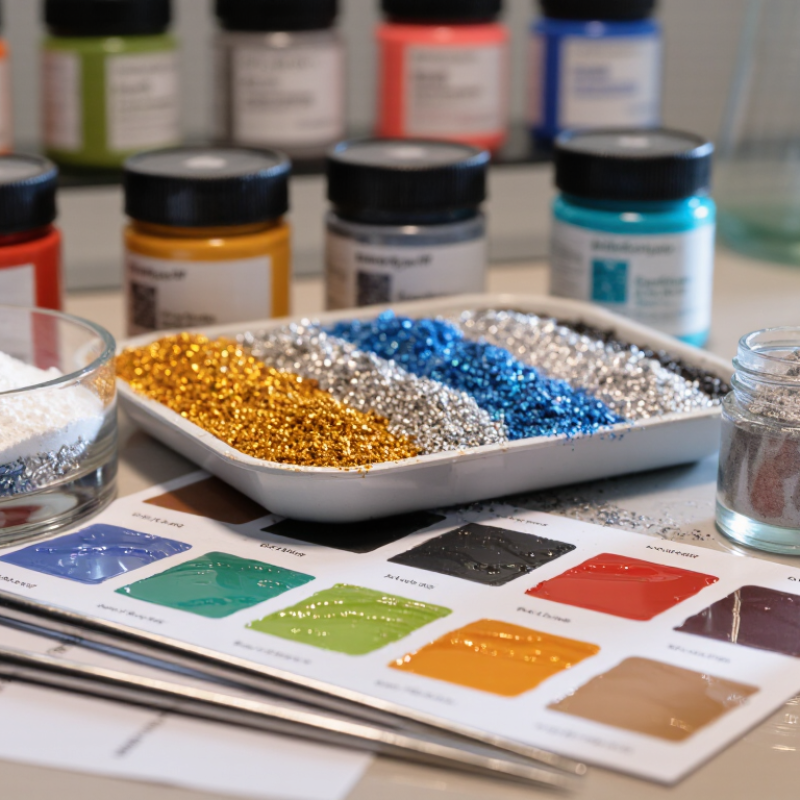
Tips: Request a technical data sheet and a retained sample. Test the powder in your actual resin, pigment load, and application method. Check dispersion under a microscope, then measure gloss using ASTM D523 at 20°, 60°, or 85°. Compare settling after storage. A bright sample may still fail in a roller coating. Ask for heavy-metal and composition documentation, even when the intended use appears simple.
2026 Best Mica Powder for Paint Global Buyers Guide
Mica powder is a naturally occurring silicate mineral valued in paint for its plate-like structure, light-reflecting appearance, barrier effect, and resistance to heat and chemicals. Particle size is a key buying consideration: finer grades generally support smoother coatings, while coarser grades can create more texture and visual sparkle.
The chart shows nominal sieve openings commonly used to describe mica powder grades. Values are based on standard U.S. sieve designations and should be treated as screening references rather than guaranteed particle-size distributions. Actual coating performance also depends on mica mineral type, aspect ratio, surface treatment, dispersion method, and paint formulation.
Key Types of Mica Powder for Global Paint Applications
Mica powder selection starts with mineral structure, not color alone. Muscovite is the common choice for interior coatings because its platelets support barrier performance, smooth texture, and controlled sheen. Fine muscovite can improve brush feel, while coarser grades create visible sparkle. Phlogopite offers better heat resistance and darker natural tones, making it useful for industrial coatings and textured finishes. Sericite, a fine-grained mica, helps produce a silky surface with lower visual roughness. The U.S. Geological Survey separates mica into sheet, scrap, and flake categories, confirming that form and particle size matter during procurement (USGS, Mineral Commodity Summaries 2025).
Synthetic fluorphlogopite provides cleaner brightness and more consistent appearance than many natural grades. It is often selected for pearlescent and decorative paint effects. However, it usually costs more, so its value depends on appearance targets rather than volume alone. Natural mica may contain iron, moisture, or variable platelet sizes. These differences can change opacity, viscosity, and settling behavior. A practical test should measure particle-size distribution, oil absorption, moisture, pH, and brightness. ISO 787 pigment testing methods provide useful procedures for several of these checks.
Recent market assessments continue to identify paints and coatings as an important mica end use (Grand View Research, Mica Market Analysis, 2024). Still, market growth does not guarantee suitability for every formulation. I would test two or three grades in the actual resin system. Laboratory results can look promising, yet production mixing may reveal floating, poor dispersion, or unexpected gloss. That gap deserves attention.
Choosing the Best Mica Powder for Different Paint Formulations
Choosing the best mica powder begins with the paint formulation, not the glitter effect. Waterborne acrylic paints usually need clean, low-dust mica with stable wetting. Solventborne coatings can accept broader surface treatments, but poor dispersion may create floating flakes or sediment. For a satin wall finish, fine particles around 10–60 microns often produce smoother coverage. Larger platelets create stronger sparkle and texture.
Grand View Research’s 2024 mica market analysis indicates roughly 4% annual growth through 2030. MarketsandMarkets’ 2024 paints and coatings report also projects steady global expansion, driven by architectural and industrial demand. These figures support careful sourcing, but they do not replace laboratory testing. Report definitions differ by region.
In practical trials, compare three grades at equal loading, such as 2%, 5%, and 8%. Check gloss, hiding power, viscosity, settling, and rub resistance after seven days. A high-aspect-ratio grade may brighten metallic finishes, while excessive loading can weaken adhesion.
For exterior paint, inspect moisture resistance and ultraviolet stability after accelerated exposure. Do not rely only on the supplier’s color card. It can mislead.
Particle cleanliness matters. Iron contamination may shift pale coatings toward gray or brown. I have also seen attractive samples fail after roller application because the flakes aligned unevenly. That result is frustrating, but useful. The best powder is the one that survives mixing, application, storage, and field handling—not merely the brightest sample.
Global Buying, Compliance, Packaging, and Supplier Considerations
Buying mica powder for paint in 2026 requires more than comparing brightness and price. Grand View Research valued the global paints and coatings market at about USD 206.6 billion in 2023. Its forecast indicates continued growth through 2030. That pressure can reward reliable mineral fillers. It can also expose weak supply controls. The 2025 USGS Mineral Commodity Summaries separates sheet, scrap, and ground mica, showing why broad production figures can mislead buyers.
Request a current SDS, certificate of analysis, and batch traceability record. Check particle-size distribution, moisture, oil absorption, whiteness, and heavy-metal results. For European sales, review REACH registration status and CLP classification. For the United States, confirm TSCA and workplace-labeling requirements. Screen for crystalline silica and geological contaminants when the deposit requires it. A supplier’s statement is useful, but independent testing is safer. I would not approve a full container from one laboratory sample.
Packaging needs practical detail. A 20–25 kilogram kraft bag with a sealed polyethylene liner can reduce moisture pickup. FIBC shipments should specify lifting design, liner material, stitching, and drop-test expectations. ISO 21898 offers a useful reference for flexible intermediate bulk containers. Ask how pallets are wrapped, labeled, and protected from rain. Port storage is often overlooked. Suppliers should disclose mine origin, processing location, production capacity, rejected-batch procedures, and lead-time history. Low cost still attracts buyers. It is not always the economical choice. One missing batch record can delay a paint shipment for weeks.