Inquiry
Form loading...
China has a broad network of manufacturers and distributors serving the decorative coatings market. Finding the right Mica Paint Powder supplier takes more than comparing prices or glossy product photos. Buyers need consistent color, suitable particle sizes, reliable batches, and clear technical information. A sample can look striking under showroom lights, yet appear different on a painted panel. Test it in the actual coating system.
This article explores how to assess leading Chinese suppliers without treating a ranking as a guarantee. Useful checks include product specifications, sample performance, production experience, quality-control practices, and responsive technical support. Ask for current technical data and safety information, then compare the powder’s appearance and dispersion in your own formulation. Small details matter.
Packaging and communication deserve attention too. A supplier should explain available grades, color options, minimum orders, and lead times in plain terms. Where possible, request batch records and clarify how color consistency is monitored. Still, no checklist can replace careful evaluation. Even experienced buyers can overlook a mismatch between a sample and a full production batch. The sections ahead offer practical questions for comparing suppliers, spotting gaps in product information, and building a shortlist suited to your coating needs. A polished catalog is a starting point, not proof of performance.
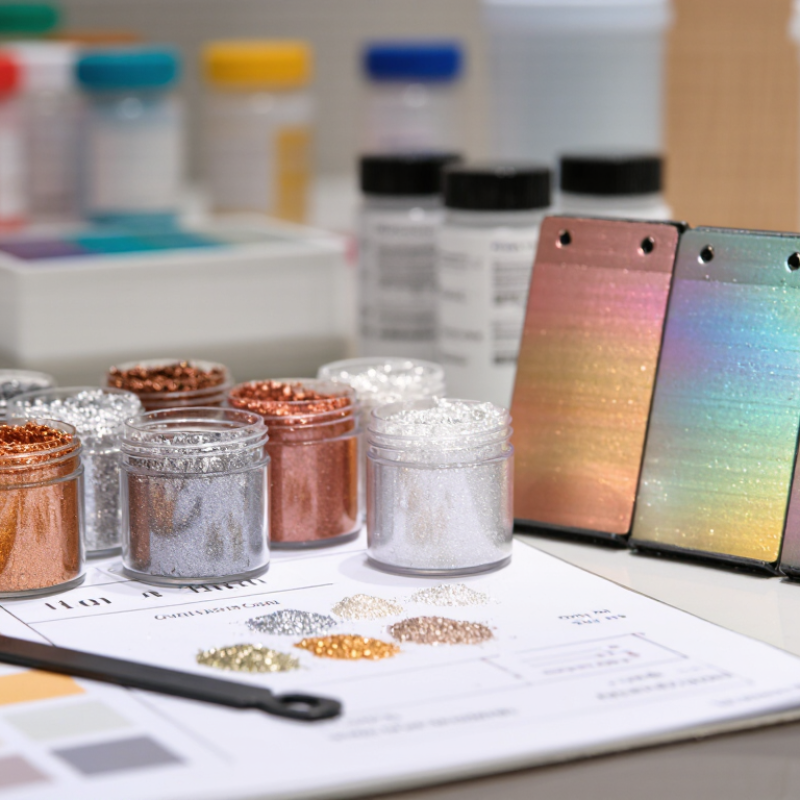
Mica paint powder is a decorative pigment made from thin mineral flakes, often coated with colorants or metal oxides. In paint, the platelets reflect and scatter light, creating a soft shimmer instead of a flat color. The appearance shifts with the viewing angle. Some finishes look pearly; others seem more metallic.
Manufacturing usually starts with mica that is cleaned and milled to a chosen particle size. Oversized flakes are screened out, while finer grades can give a smoother finish. The flakes may then be coated, dried, sieved, and checked for color consistency and particle distribution. That matters. Test it. Mix a small sample into the intended paint base and brush it onto a test panel. Stir gently, since aggressive mixing may damage flakes or make the shimmer uneven. Results also depend on the binder, film thickness, and application method. Ask suppliers for particle-size details and a recent sample. I would treat a color chart as a guide, not a promise; lighting and screen settings can hide real differences. Not every batch behaves identically.
| Category | What It Covers | Typical Products or Process | Relevance to Paint | What Buyers Should Verify |
|---|---|---|---|---|
| Supplier Types and Product Selection | ||||
| Natural mica powder processor | Processes mica mineral into flakes or powder for industrial use. | May offer muscovite or phlogopite mica in different particle-size grades. | Plate-like particles can contribute to a smooth appearance and help reinforce a coating film. | Confirm mineral type, particle-size distribution, color, moisture, and batch consistency using a current technical data sheet and sample. |
| Wet-ground mica processor | Uses water during milling and subsequent separation or drying. | Wet grinding can produce fine, relatively smooth mica flakes; results depend on the equipment and process settings. | May suit coatings that need controlled flake shape or a smooth finish. | Ask about flake dimensions, surface condition, residual moisture, drying method, and compatibility with the intended coating system. |
| Dry-ground mica processor | Reduces mica size without water-based grinding. | Produces grades with particle sizes and shapes determined by the milling and classification process. | Can be considered for general-purpose paint formulations where the grade meets the required appearance and performance. | Check particle-size distribution, coarse-particle content, dust handling information, and performance in a trial formulation. |
| Mica-based pearlescent pigment producer | Applies one or more optical coatings to mica platelets. | Many pearlescent pigments use mica substrates coated with materials such as titanium dioxide or iron oxides. | Can create interference, pearlescent, or colored effects in paints and coatings. | Verify coating composition, color and effect grade, lightfastness data, regulatory documentation, and suitability for the end use. |
| Custom-grade supplier | Develops or selects a grade to meet a buyer’s application requirements. | May adjust particle-size range, surface treatment, or packaging specifications. | Useful when standard grades do not provide the desired finish, dispersion, or processing behavior. | Agree on measurable specifications, test methods, sample approval, change control, and lot-to-lot acceptance criteria. |
| What Mica Paint Powder Is and How It Is Made | ||||
| Material | Mica is a group of naturally occurring sheet silicate minerals. | Common commercial mica types include muscovite and phlogopite. | Mica particles are valued for their plate-like shape; optical effects depend on the material, particle characteristics, and any surface coating. | Confirm whether the product is uncoated mica powder or a coated mica-based pigment; the terms are not interchangeable. |
| Mining and sorting | Raw mica-bearing material is extracted and separated from unwanted rock or other minerals. | Sorting and cleaning prepare the feedstock for further processing. | Feedstock quality affects the appearance and consistency of the final powder. | Request origin and mineral-composition information where required, plus documentation relevant to the intended market. |
| Grinding and classification | Prepared mica is milled and separated into particle-size fractions. | Processing may use dry or wet grinding, followed by screening or other classification methods. | Particle size and flake shape influence appearance, dispersion, and coating behavior. | Specify the particle-size measurement method and request a distribution rather than relying only on a single nominal size. |
| Optional surface coating | For pearlescent grades, mica platelets may receive thin layers of optical materials. | Coating and processing conditions determine the resulting color and interference effect. | Coated grades are used when a paint requires a pearlescent or special-effect finish. | Check composition, performance data, applicable safety documents, and any market-specific compliance requirements. |
| Supplier comparison | A “top supplier” ranking depends on the application and current, independently verified supplier information. | Compare suppliers by product fit, documented quality controls, technical support, capacity, and delivery terms. | A sample tested in the actual paint formulation is more informative than a generic product description. | Request a current technical data sheet, safety data sheet, representative sample, quality documentation, and written specifications before purchase. |